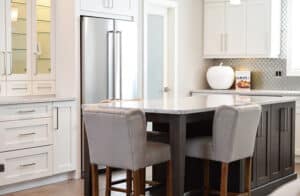
We cannot overstate the importance of ergonomics in kitchen design. Ergonomics is the science of designing environments for human use, and plays a huge role in how comfortable, efficient, and safe your kitchen becomes over time. And if you’re planning a renovation, especially with a flat pack kitchen, getting the ergonomics right from the start can save you years of inconvenience.
At its core, ergonomic design is all about reducing unnecessary effort. It starts with height, specifically the height of your benchtops. Standard benchtops are around 900mm high, which suits most people. But if you’re particularly tall or short, adjusting this slightly can improve your comfort significantly. The goal is to keep your elbows at a relaxed angle while preparing food, reducing strain on your back and shoulders during repetitive tasks like chopping or stirring.
Another key factor is how you move through the kitchen. The traditional “work triangle” – the path between your fridge, cooktop, and sink – is still a useful principle, but modern kitchens often benefit from thinking in terms of zones. Having clear areas for preparation, cooking, and cleaning helps create a more intuitive flow. This means placing your chopping board close to the fridge, your bin under the sink, and keeping your cookware near the oven. Everything you use most should be within arm’s reach of where you use it.
Cabinet access is another area where ergonomics really matters. Deep drawers are generally easier to use than traditional cupboards because they pull out fully and let you see and reach everything inside without crouching or stretching. Overhead cupboards should be within reach, but not so low that you bump your head or obstruct your view of the bench. For higher storage, adding a step-stool cupboard or pull-down shelf can make everyday items accessible without awkward reaching.
Lighting plays an important ergonomic role too. Shadows over your prep space can lead to mistakes, or worse, accidents. Task lighting under your overhead cabinets ensures that your working surfaces are always well-lit. Meanwhile, softer ambient lighting in dining or relaxation zones can reduce eye strain and make your kitchen more welcoming.
Even your flooring can influence how your kitchen feels to use. Hard surfaces like tiles are easy to clean, but standing on them for long periods can be tiring. If you’re someone who spends hours cooking or baking, consider adding a cushioned mat near the sink or stove to reduce fatigue in your legs and lower back.
Thoughtful design also includes safe and efficient appliance placement. Wall ovens, for example, are often easier to use than under-bench ones because they reduce bending. Dishwashers installed slightly above floor level are more ergonomic for stacking and emptying. And don’t forget about clearance zones: make sure fridge and dishwasher doors can open fully without hitting nearby cabinetry or blocking traffic.
By focusing on ergonomics, you create a kitchen that works with you, not against you. These details might not be as eye-catching as a statement benchtop or bold splashback, but they’ll have a far greater impact on how you feel in the space day after day.
At Kit Kitchens, our designs are built with real use in mind. Whether you’re installing your kitchen yourself or working with a tradesperson, we help you plan smart layouts that don’t just look good, they feel good too.